
 Admin
Admin
Healthy high-protein chicken bowl recipes: fuel your body, satisfy your taste buds
You already know chicken is a lean protein powerhouse. But are you actually eating it in a way that’s satisfying, nutritious, and something you genuinely look forward to? That’s where healthy high-protein chicken bowl recipes completely change the game.
Bowls are the ultimate meal format for people who care about what they eat but refuse to be bored by it. Stack the right ingredients seasoned chicken, complex carbs, vibrant vegetables, and a sauce that ties everything together and you’ve got a meal that hits every macronutrient target while actually tasting incredible.
Whether you’re eating for muscle gain, fat loss, meal prep efficiency, or just cleaner everyday nutrition, this guide gives you everything you need: recipes, techniques, protein breakdowns, and the building blocks to create your own variations endlessly.
1. Why chicken bowls are the ultimate high-protein meal
There’s a reason chicken bowls have become a staple in fitness communities, meal prep culture, and health-conscious households worldwide. They work on every level.
A single well-built chicken bowl can deliver 40–55 grams of protein per serving, depending on portion size and ingredients. That’s more than most protein shakes, with the added benefit of real food fiber, micronutrients, healthy fats, and complex carbohydrates that keep energy levels stable for hours.
Here’s what makes chicken bowls so effective for high-protein eating:
- Chicken breast offers roughly 31g of protein per 100g one of the highest protein-to-calorie ratios of any whole food
- Bowl format allows easy macro customization without sacrificing flavor
- They’re naturally modular swap one component and you have an entirely different meal
- Meal prep friendly most components store separately and reheat without losing quality
- Works across almost every dietary framework: low-carb, paleo, Mediterranean, gluten-free, dairy-free
2. Understanding protein: how much do you actually need?
Before building your bowls, it helps to understand the nutrition goal behind them.
2.1 Daily protein targets for active adults
The general recommendation for active adults aiming to build or maintain muscle is 0.7–1g of protein per pound of bodyweight (or 1.6–2.2g per kg). For a 160-pound person, that’s roughly 112–160g of protein per day.
A single high-protein chicken bowl built correctly can cover 30–40% of that daily target in one meal. That’s efficient nutrition.
2.2 Why chicken is the best protein base for bowls
Chicken is not just high in protein it’s a complete protein, meaning it contains all nine essential amino acids your body can’t produce on its own. It’s also:
- Low in saturated fat, especially breast meat
- Rich in B vitamins, particularly B3 (niacin) and B6
- A good source of selenium and phosphorus
- Extremely versatile in flavor it takes on marinades, spice rubs, and sauces beautifully
3. The anatomy of a perfect high-protein chicken bowl
Every great bowl is built on the same structural foundation. Master this framework and you’ll never need to follow a recipe exactly again.
3.1 Layer 1: the base (complex carbs or greens)
This is what gives the bowl substance and satisfying energy. Choose one:
- Brown rice 5g protein per cup, high fiber, slow-digesting carbs
- White rice faster energy, pairs well with Asian-inspired flavors
- Quinoa 8g protein per cup, complete protein, gluten-free
- Cauliflower rice low-carb option, about 25 calories per cup
- Mixed greens or romaine for a salad-style high-protein bowl
- Farro or barley nutty, chewy, excellent texture contrast
- Sweet potato natural sweetness, rich in potassium and vitamin A
3.2 Layer 2: the protein (chicken, prepared your way)
This is the centerpiece. Aim for 150–200g of cooked chicken per bowl for 45–60g of protein from the chicken alone.
Best cooking methods for bowl chicken:
- Grilled char marks, smoky flavor, great with grain bases
- Baked hands-off, consistent results, ideal for meal prep
- Pan-seared golden crust, juicy interior, fast on weeknights
- Poached and shredded softer texture, absorbs sauces easily
- Air-fried crispy exterior with minimal oil
3.3 Layer 3: the vegetables
This is where micronutrients, fiber, and color come in. Mix raw and cooked for texture contrast:
- Roasted broccoli, zucchini, or bell peppers
- Fresh cucumber, shredded red cabbage, or cherry tomatoes
- Steamed edamame or corn
- Pickled red onions (adds brightness and acidity)
- Roasted sweet potato or butternut squash
3.4 Layer 4: the sauce or dressing
This is what transforms a bowl from “healthy but boring” into genuinely craveable. A good sauce also adds healthy fats that improve nutrient absorption.
- Tahini lemon dressing creamy, earthy, Mediterranean vibes
- Sriracha honey sweet heat, works on almost everything
- Peanut sauce rich, Asian-inspired, pairs with rice and slaw
- Greek yogurt tzatziki cool, high-protein bonus sauce
- Avocado lime dressing healthy fats, vibrant flavor
- Teriyaki glaze sweet-savory, great with sesame and ginger
3.5 Layer 5: the finishing touches
Small additions that make a big impact:
- Sesame seeds, pumpkin seeds, or hemp hearts (extra protein and crunch)
- Fresh herbs cilantro, parsley, mint, or basil
- Sliced avocado or a squeeze of lime
- Crumbled feta or shaved parmesan
- A soft or hard-boiled egg for an extra protein boost

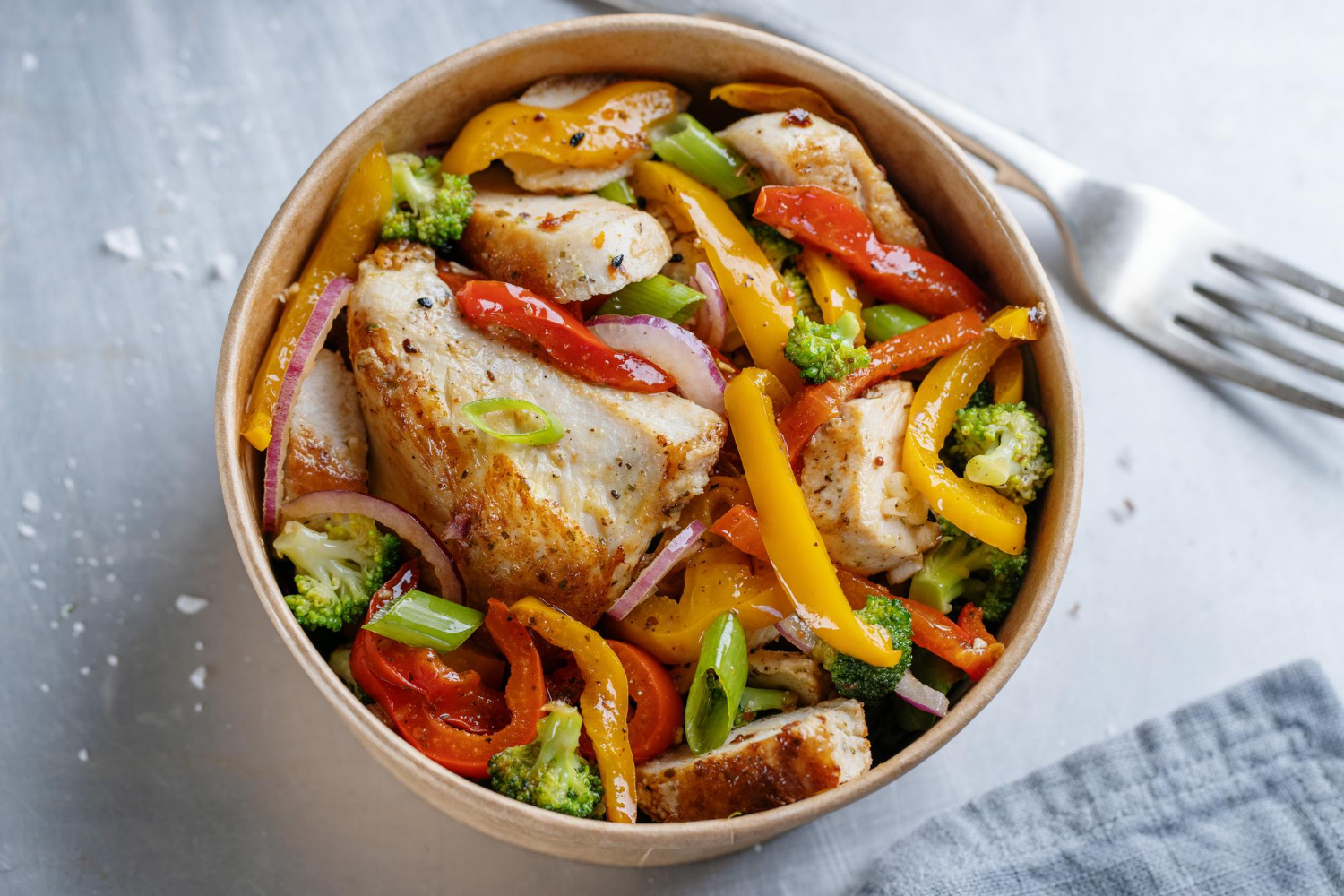
4. The best healthy high-protein chicken bowl recipes
4.1 Classic grilled chicken and brown rice bowl
The foundational high-protein bowl. Simple, reliable, and endlessly adaptable.
Macros per serving (approx.): 520 calories | 48g protein | 52g carbs | 12g fat
Ingredients (serves 2):
- 300g chicken breast, grilled and sliced
- 1 cup cooked brown rice
- 1 cup roasted broccoli florets
- ½ cup cherry tomatoes, halved
- ¼ avocado, sliced
- 2 tbsp tahini lemon dressing
- Salt, pepper, garlic powder, smoked paprika
To make it:
- Season chicken with salt, pepper, garlic powder, and paprika. Grill on medium-high heat 5–6 minutes per side until internal temp reaches 165°F.
- Roast broccoli at 425°F (220°C) for 18–20 minutes with olive oil and salt.
- Assemble: rice base, sliced chicken, roasted broccoli, tomatoes, avocado.
- Drizzle with tahini dressing and serve immediately or refrigerate for meal prep.
4.2 Teriyaki chicken bowl with edamame
Sweet, savory, and deeply satisfying. This is a crowd-pleaser with serious protein credentials.
Macros per serving (approx.): 560 calories | 52g protein | 58g carbs | 10g fat
Ingredients (serves 2):
- 300g chicken thighs, boneless and skinless
- 1 cup cooked white or brown rice
- ½ cup shelled edamame
- ½ cup shredded red cabbage
- 1 medium carrot, julienned
- 3 tbsp teriyaki sauce (low-sodium preferred)
- Sesame seeds and sliced green onions to finish
To make it:
- Cook chicken in a pan over medium-high heat, 5 minutes per side. Brush with teriyaki sauce in the final 2 minutes of cooking.
- Let chicken rest 3 minutes, then slice thinly.
- Assemble: rice base, teriyaki chicken, edamame, cabbage, carrots.
- Drizzle extra teriyaki sauce, top with sesame seeds and green onions.
4.3 Mediterranean chicken bowl with quinoa and tzatziki
High protein from multiple sources chicken, quinoa, and Greek yogurt in the tzatziki. Light, fresh, and deeply nourishing.
Macros per serving (approx.): 490 calories | 50g protein | 40g carbs | 14g fat
Ingredients (serves 2):
- 280g grilled or baked chicken breast
- 1 cup cooked quinoa
- ½ cucumber, diced
- ½ cup cherry tomatoes, halved
- ¼ red onion, thinly sliced
- 2 tbsp kalamata olives
- 30g crumbled feta
- 4 tbsp tzatziki (Greek yogurt, cucumber, garlic, dill, lemon)
To make it:
- Season and bake chicken at 400°F (200°C) for 22–25 minutes. Slice or shred when cool.
- Make quick tzatziki: mix ½ cup Greek yogurt, ¼ grated cucumber (squeezed dry), 1 garlic clove minced, 1 tsp dill, juice of ½ lemon. Season with salt.
- Assemble: quinoa base, chicken, cucumber, tomatoes, onion, olives, feta.
- Top generously with tzatziki.
4.4 Spicy sriracha chicken bowl with cauliflower rice
A low-carb high-protein option that doesn’t feel like a compromise. The sriracha honey sauce makes this bowl genuinely addictive.
Macros per serving (approx.): 380 calories | 47g protein | 18g carbs | 12g fat
Ingredients (serves 2):
- 300g chicken breast, cubed and pan-seared
- 2 cups cauliflower rice, sautéed
- 1 cup roasted bell peppers
- ½ cup corn kernels
- 1 tbsp sriracha
- 1 tbsp honey
- 1 tbsp soy sauce or coconut aminos
- Lime wedge and cilantro to finish
To make it:
- Mix sriracha, honey, and soy sauce in a small bowl.
- Pan-sear cubed chicken in a hot oiled skillet for 810 minutes until cooked through.
- Toss chicken in the sriracha honey sauce.
- Sauté cauliflower rice with salt and garlic for 4 minutes.
- Assemble: cauliflower rice, sauced chicken, peppers, corn.
- Finish with lime juice and fresh cilantro.
4.5 Peanut sesame chicken bowl with soba noodles
Soba noodles bring a satisfying chew and extra protein. The peanut sesame sauce is genuinely one of the best things you can put on chicken.
Macros per serving (approx.): 580 calories | 46g protein | 55g carbs | 18g fat
Ingredients (serves 2):
- 280g chicken breast, grilled and sliced thin
- 150g cooked soba noodles
- 1 cup shredded red cabbage
- 1 medium carrot, julienned
- ½ cup edamame
- Sesame seeds and green onions
For peanut sauce:
- 3 tbsp natural peanut butter
- 2 tbsp soy sauce
- 1 tbsp rice vinegar
- 1 tsp sesame oil
- 1 tsp grated ginger
- 1 tbsp warm water to thin
To make it:
- Whisk all peanut sauce ingredients together. Adjust consistency with water.
- Toss cooked soba noodles with half the peanut sauce.
- Assemble: noodle base, sliced grilled chicken, cabbage, carrot, edamame.
- Drizzle remaining peanut sauce over top. Finish with sesame seeds.
4.6 Buffalo chicken burrito bowl
All the flavors of a buffalo wing, built into a high-protein bowl. Perfect for those who want bold flavor without compromising nutrition.
Macros per serving (approx.): 530 calories | 51g protein | 48g carbs | 14g fat
Ingredients (serves 2):
- 300g chicken breast, shredded
- 3 tbsp buffalo sauce (Frank’s RedHot is classic)
- 1 cup cooked brown rice or farro
- ½ cup black beans, rinsed
- ½ cup corn
- ½ cup diced celery
- 2 tbsp Greek yogurt ranch (Greek yogurt + ranch seasoning)
- Crumbled blue cheese or feta (optional)
To make it:
- Bake or poach chicken until cooked through. Shred using two forks.
- Toss shredded chicken with buffalo sauce.
- Assemble: rice base, buffalo chicken, black beans, corn, celery.
- Drizzle with Greek yogurt ranch. Top with cheese if using.
5. High-protein chicken bowl meal prep guide
5.1 How to meal prep chicken bowls for the week
Building a week of protein-rich meals takes about 45–60 minutes on a Sunday. Here’s the approach that works:
- Cook a large batch of chicken bake 600–800g at once. Season half with one profile (Mediterranean), the other half with another (teriyaki or buffalo).
- Cook two grains simultaneously one pot of brown rice, one pot of quinoa. Both store well for 5 days.
- Roast a sheet pan of vegetables broccoli, peppers, zucchini all together at 425°F for 20 minutes.
- Make 1–2 sauces store in small jars in the fridge. Most last 5–7 days.
- Assemble daily, not all at once keep components separate and build bowls fresh each day. This prevents sogginess and gives you flexibility to change combinations throughout the week.
5.2 Storage tips for maximum freshness
- Store cooked chicken in airtight containers for up to 4 days in the fridge
- Keep grains and vegetables in separate containers from sauces
- Fresh greens should be stored dry and only added at serving time
- Avocado should be sliced fresh it browns quickly
- Most bowl components freeze well for up to 3 months, except raw vegetables and creamy sauces
6. How to hit 40–50g of protein in a single chicken bowl
If you have specific protein targets common for athletes, bodybuilders, or anyone in a muscle-building phase use this stacking approach:
| Ingredient | Protein |
|---|---|
| 170g grilled chicken breast | ~40g |
| ½ cup cooked quinoa | ~4g |
| ½ cup edamame | ~8g |
| 1 large egg (hard-boiled, halved) | ~6g |
| 4 tbsp Greek yogurt sauce | ~5g |
| Total | ~63g |
Combining chicken with plant-based protein boosters edamame, quinoa, beans, hemp seeds, Greek yogurt is the most efficient way to maximize protein per bowl without oversizing your chicken portion.
7. Best sauces and dressings for high-protein chicken bowls
The sauce is never an afterthought. Here are five that consistently elevate any chicken bowl:
7.1 High-protein Greek yogurt ranch
Mix: 1 cup plain Greek yogurt + 1 tsp garlic powder + 1 tsp onion powder + 1 tsp dried dill + ½ tsp salt + juice of ½ lemon. Adds 10–12g protein per serving compared to 0–1g in regular ranch.
7.2 Tahini lemon dressing
Mix: 3 tbsp tahini + juice of 1 lemon + 1 garlic clove (minced) + 3–4 tbsp water to thin + salt. Rich, creamy, pairs beautifully with Mediterranean and grain bowls.
7.3 Avocado lime crema
Blend: 1 ripe avocado + juice of 1 lime + ¼ cup Greek yogurt + salt + small handful of cilantro. Bright, creamy, excellent on Mexican-style bowls.
7.4 Ginger miso dressing
Mix: 2 tbsp white miso + 1 tbsp rice vinegar + 1 tsp sesame oil + 1 tsp grated ginger + 2 tbsp warm water. Deeply savory with an umami backbone that elevates any Asian-inspired bowl.
7.5 Spicy peanut sauce
Already detailed above in the soba noodle bowl recipe but worth noting as universally versatile. Works on rice bowls, noodle bowls, salad bowls, and everything in between.
8. Chicken bowl variations for every dietary goal
8.1 For fat loss: low-calorie high-protein chicken bowl
- Base: cauliflower rice or mixed greens
- Protein: 170g baked chicken breast (seasoned with herbs, no oil)
- Vegetables: roasted broccoli, cucumber, cherry tomatoes
- Sauce: lemon herb dressing (olive oil, lemon, herbs 1 tbsp)
- Target macros: ~350 calories | 42g protein | 18g carbs | 8g fat
8.2 For muscle gain: high-calorie high-protein chicken bowl
- Base: 1.5 cups brown rice + ½ cup black beans
- Protein: 200g grilled chicken thighs
- Vegetables: roasted sweet potato, corn, avocado
- Sauce: chipotle Greek yogurt crema
- Add: 1 hard-boiled egg, sprinkle of hemp seeds
- Target macros: ~700 calories | 58g protein | 72g carbs | 18g fat
8.3 For low-carb eating: keto-friendly chicken bowl
- Base: cauliflower rice or shredded lettuce
- Protein: 180g pan-seared chicken thighs
- Vegetables: roasted zucchini, bell peppers, avocado, olives
- Sauce: tahini or avocado lime dressing
- Target macros: ~430 calories | 45g protein | 12g carbs | 22g fat
9. Common mistakes to avoid when building protein bowls
Even people who eat well fall into these traps:
- Under-seasoning the chicken. Bland chicken ruins an otherwise excellent bowl. Season assertively salt, garlic, herbs, acid.
- Forgetting to rest the chicken. Let grilled or baked chicken rest 3–5 minutes before slicing. It retains significantly more moisture.
- Overloading one macronutrient. A bowl that’s all rice and chicken misses the micronutrient and satiety value of vegetables.
- Using a sauce that’s nutritionally empty. Bottled dressings are often high in sugar, sodium, and seed oils. Make your own it takes 3 minutes and makes a huge difference.
- Not varying your bowls. Eating the same combination every day leads to food fatigue and abandoned meal prep. Rotate at least 3 different bowl styles each week.
10. Conclusion: build better meals, build a better body
There is no perfect diet but there are better habits. And building healthy high-protein chicken bowl recipes into your weekly routine is one of the most impactful habits you can adopt. You get a meal that’s high in protein, rich in nutrients, fully satisfying, and adaptable enough to never get boring.
Use the framework in this guide base, protein, vegetables, sauce, finishing touches and you’ll never run out of combinations. Meal prep on Sunday. Build fresh on weekdays. Adjust the macros based on your goals. Try a new sauce every week.
The best nutrition plan is the one you can actually stick to. Chicken bowls make that remarkably easy.
Frequently asked questions about high-protein chicken bowls
Q1: How much protein is in a chicken bowl?
A well-built high-protein chicken bowl typically contains 40–60 grams of protein per serving. The exact amount depends on the chicken portion (170–200g provides roughly 40–50g protein), plus any additional protein sources like quinoa, edamame, beans, Greek yogurt sauce, or eggs added to the bowl.
Q2: Are chicken bowls good for weight loss?
Yes. Chicken bowls are excellent for weight loss because high-protein meals promote satiety and reduce overall calorie intake throughout the day. Using cauliflower rice instead of grains and loading up on non-starchy vegetables can bring a bowl down to 350–450 calories while still delivering 40+ grams of protein.
Q3: What is the healthiest base for a high-protein chicken bowl?
Quinoa is arguably the healthiest base because it’s a complete protein (8g per cup), high in fiber, gluten-free, and packed with micronutrients. Brown rice is an excellent runner-up for sustained energy. For low-carb goals, cauliflower rice is the best option with only 25 calories per cup.
Q4: Can I eat chicken bowls every day? Yes, as long as you vary the ingredients. Rotating different grains, vegetables, sauces, and chicken preparations prevents nutritional gaps and food fatigue. Eating the exact same bowl daily can lead to micronutrient imbalances and boredom variety is important for both health and adherence.
Q5: How do I meal prep chicken bowls without them getting soggy?
The key is to store all components separately and only assemble bowls at mealtime. Keep grains, chicken, vegetables, and sauces in separate containers. Add fresh greens and avocado only when serving. Most components stay fresh for 4–5 days in the refrigerator when stored this way.
Q6: What vegetables are highest in protein for chicken bowls?
The most protein-dense vegetables to add to a chicken bowl include: edamame (8g per ½ cup), green peas (4g per ½ cup), corn (3g per ½ cup), broccoli (3g per cup), and spinach (3g per cup cooked). Adding these alongside chicken significantly boosts the total protein content of the bowl.
Q7: What is the best chicken cut for a high-protein bowl?
Chicken breast is the highest in protein and lowest in fat roughly 31g protein per 100g cooked. Chicken thighs provide about 26g protein per 100g but have more fat and significantly more flavor. For pure protein optimization, use breast. For flavor and slightly more forgiving cooking, use thighs.
Q8: Are chicken bowls good for building muscle?
Absolutely. Chicken bowls are one of the most practical muscle-building meals you can eat. They combine complete protein from chicken with complex carbohydrates for energy and recovery, healthy fats for hormone production, and vegetables rich in micronutrients that support overall performance. Aim for 50–60g protein per bowl during a muscle-building phase.
Q9: What sauce is healthiest for a high-protein chicken bowl?
Greek yogurt-based sauces like tzatziki or high-protein ranch are the healthiest option because they add additional protein (10–12g per serving) along with probiotics and calcium, while keeping calories low. Tahini-based dressings are also excellent for healthy fats and micronutrients. Avoid bottled dressings high in added sugar and refined oils.
Q10: Can chicken bowls be made gluten-free?
Yes, all the recipes in this guide are naturally gluten-free or easily adapted. Use tamari instead of soy sauce, choose certified gluten-free oats or soba noodles if including them, and verify that any bottled sauces or teriyaki glazes are labeled gluten-free. Rice, quinoa, cauliflower rice, and most vegetables are inherently gluten-free bases.

GIPHY App Key not set. Please check settings